


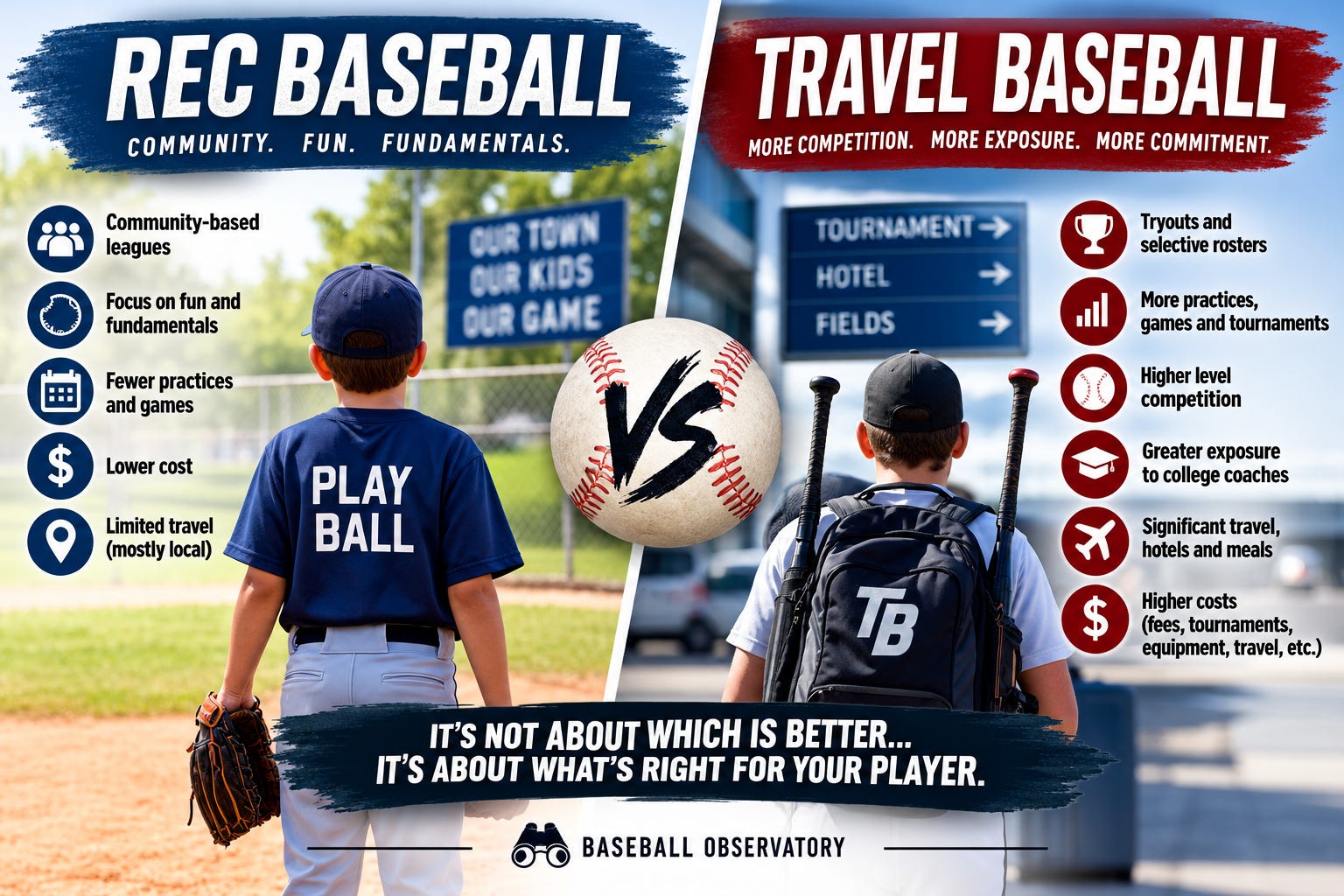
Is recreational or travel baseball the right fit for your player? The differences can be significant. To make that determination, communicate with your player to understand their goals and what is important to them. Do they desire to play with their local friends, or do they value increased competition? Current skill level may weigh on that decision as well, especially as they reach high school age.
Which would be more fun in the player’s eyes? Always strive to keep it fun.
Rec ball is open to everyone, where travel ball is selective and usually requires a true tryout. Rec leagues may hold “tryouts” but everyone gets placed on a team. Some rec leagues offer a “select” offering. League members can try out and join a team that plays tournaments and other more competitive teams (including some travel teams).
Rec Baseball
Rec baseball generally has geographic boundaries that require most team members to live in the area where the league exists. These rec leagues have fewer practices and focus on fundamentals. The leagues maintain participation requirements around playtime as well.
Rec ball is lower cost and involves less travel. They have fewer tournaments. As a result, there is typically less of a time and financial commitment compared to travel ball.
Coaches are usually volunteers, and that’s one key factor in keeping costs lower.
These leagues are great for those just starting in baseball or developing their interest in baseball. Rec league quality can vary greatly depending on the area where located.
Travel Baseball
Travel baseball has evolved into a varied compilation of large national organizations, independent teams, and smaller organizations (and probably everything in between). Travel teams are more selective and often require true tryouts to make the team. Playtime is not guaranteed, and fees are higher.
As players have migrated away from rec ball to travel ball, the level of competition has changed as well. Where early travel teams were created to find better competition, it often required them to travel out of the local area. In many areas today, there are enough teams to find good competition in the local area (at least for most populated areas).
Travel teams practice more often and play more tournaments (with most requiring travel). So equipment, tournament fees, facilities, hotels, meals, and gate fees require a larger investment. Many teams have paid coaches well to add into the cost. In addition to the cost, time away from home may also become a concern.
The key here is to determine if the investment improves the development of the player. Depending upon the age, goals, and skill of the player, which one is the better choice. For some it could mean less play time, but better instruction and development.
Everyone’s path is unique, but a simple rule of thumb is to ask “what does the player need to be ready for the next level?” Where’s the best place to get that?
Travel ball typically drives private instruction as well. While team practice happens more often, it does not replace individual work and training.
Development vs. Competition
Rec and travel ball each provide development and competition. Which better meets the needs of your player? Is sitting on the bench for a more competitive team as good as significant playing time on a less competitive team? Players respond differently to those situations and finding a way to get the right balance is key.
Coach quality needs to be assessed and considered. Are they appropriate for the age to develop baseball IQ, confidence, and fundamental skills, while keeping it fun. If the player no longer has fun, he’s close to the end of the journey.
It’s a lot to consider, but understand the player’s goals before deciding.
College Recruiting
If your player is interested in playing in college, travel ball may afford more opportunities overall. Playing travel does not automatically provide more exposure for recruiting. While it can provide play against better competition, playing in the right venues is still a consideration. Playing in local or even regional tournaments does not guarantee exposure. National and invitational tournaments will provide more opportunities, but even playing in those, exposure is not guaranteed.
Skills, academics, performance (against good competition), and exposure are all important to the recruiting process. Travel ball does not guarantee any of these.
Make sure to match your choice of team and league with the goals of the player. Neither travel nor rec is “better” than the other. The match for your player is the most important. As players age beyond 12U, goals will become apparent. Understanding what the next level is, and the player’s goals will drive that decision. Whether the next level is middle school, high school, or college, figure out what the next steps are for your player to be ready for the next level.
Remember, none of it matters if your player stops having fun.