


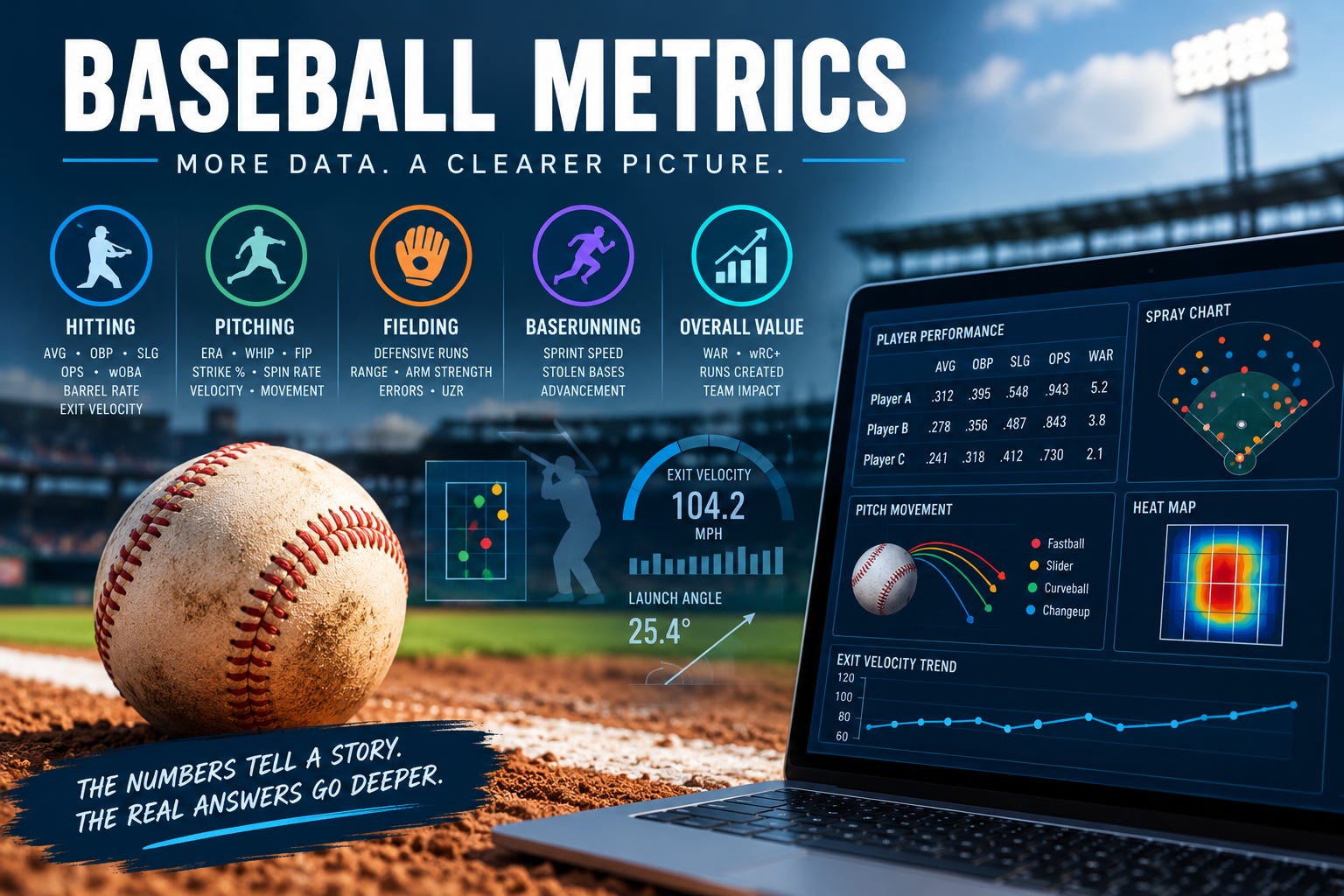
Baseball has become a numbers game, with more statistics and metrics available than ever before. With the proliferation of improved technology, players are increasingly under a microscope. Trackman and Rapsodo have provided additional visibility into gameplay for both batters and pitchers. Even with the additional statistics and metrics, they do not necessarily lead to improved evaluations. Using metrics and statistics as tools is the right approach. Don’t make improving the metric become the goal. How each statistic and metric affect the ability to play the game is important. Leverage the tools to improve your gameplay.
Before diving into the evolution, let’s define a couple terms that are sometimes used interchangeably. Statistics and metrics are just evidence. Metrics measure a particular facet of performance at a point in time, like velocity, exit velocity, and 60 times. Statistics collect data on various facets of gameplay over a period of time. For example, think batting average, plate appearances, hits, and strikeouts. Evaluations look at the results of metrics and statistics, but should further define how they will impact play going forward.
Evolution of Metrics
Most are familiar with the traditional baseball statistics. Teams collect these as part of scorekeeping the games. They include batting average, home runs, RBIs, ERA, wins, and strikeouts. These are the baseline stats from which the Sabermetrics are derived. Sabermetrics comes from the Society for American Baseball Research (SABR) and analyzes traditional statistics to better understand player value and team performance. These are the factors that contribute to winning. Examples of Sabermetrics include on-base percentage, slugging percentage, WHIP and OPS.
From the traditional and Sabermetrics, we now have modern tracking metrics. Advanced technology captures these metrics which include launch angle, exit velocity, spin rate, and pitch movement. With improved technology and thought leadership, each new metric answered questions that the previous generation could not. Coaches, scouts, and players can identify trends that were difficult or impossible to previously identify. They can review trends, measure data over time, and compare performance across different environments. The statistics provide objective data for recruiting and evaluation. The metrics enable players to develop more specific goals to pursue. There is a risk with chasing just one measurable metric. For example, chasing velocity without command can create a distraction from overall improvement. While many pitchers who have worked to increase velocity, they have neglected command. They have found that once on a roster, coaches expect pitchers to get outs. Pitchers who fail to find the zone have pretty short outings.
It is important to remember that metrics are evidence and support evaluation. The metrics are not the evaluation.
Metrics vs. Evaluation
When developing the process for evaluation, the metric answers the question of what happened. By adding some context and analysis, we can answer why it happened. Many stop there when dealing with metrics and statistics. Analyzing consists of combining individual metrics to develop a more complete picture. Even after analysis there remain blind spots.
To address the blind spots, scouts need to observe the players. The metrics should be the beginning of the conversation, not the end. For example, a pitcher is throwing 85 mph (base metric). It’s important to know his strike percentage as well. Even that doesn’t tell the whole story. By observing the pitcher’s arsenal and how those pitches play, we get a better sense of the player’s effectiveness. Then we can evaluate how often and consistently he gets hitters out.
We cannot evaluate players with metrics alone. We have to use metrics, analysis, and observation to create a more complete picture when evaluating players. There are many facets of a player’s performance that are not captured by metrics. Metrics do not measure baseball IQ, coachability, leadership, or work ethic. Can the player make adjustments? With all the data available, making an improvement to a metric requires skill to identify and positively impact their performance.
For recruiting, coaches need to consider the metrics, but they cannot let the “number” become the player. There are too many additional dimensions to consider before offering. In addition to the metrics, coaches need to evaluate overall athleticism, physical projection, how the players perform against quality competition, potential positional needs, and overall team fit.
Developing a complete picture of a player is critical for recruiting success. With all the data available today, it’s easy to miss the non-tangible but important aspects of a complete player. Using observation, metrics, and analysis to produce an effective and complete evaluation will help us answer that question from Money Ball, “If he’s a good hitter, why don’t he hit good?”